
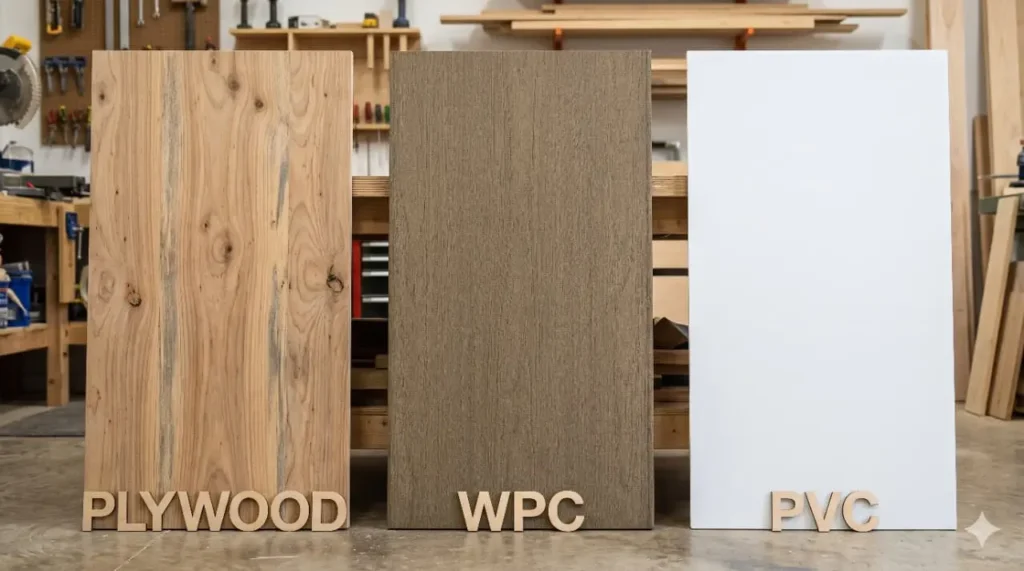
For most Kerala kitchens, the best setup is a mix. Use IS 710 marine (BWP) plywood for base units and tall units, where strength and hardware support matter most. Use PVC or WPC foam board for the under-sink cabinet, where leaks and damp are most likely. Plywood holds hinges and drawer channels best. PVC and WPC do not soak up water, but their quality varies a lot with density.
Planning a modular kitchen in Kannur or anywhere in Kerala? This guide compares the three materials on water resistance, strength, screw holding, cost and the right use for each part of your kitchen, so you can choose with confidence.
Why Kerala kitchens need a careful material choice
A Kerala kitchen faces months of monsoon humidity on top of daily steam, heat, spills and the risk of termites. A board that performs well in a dry climate can swell, delaminate or lose its screw grip here.
The cabinet body (the carcass) is the part you cannot easily replace later. Shutters and finishes can be changed. A swollen or weakened carcass means rebuilding the kitchen. That is why the board behind the laminate matters more than the colour on the front.
Plywood vs WPC vs PVC at a glance
| Feature | Marine plywood (IS 710) | WPC foam board | PVC foam board |
|---|---|---|---|
| Made of | Wood veneers bonded with waterproof resin | Wood fibre or powder mixed with PVC, foamed | Foamed PVC, no wood |
| Water and humidity | Very good when genuine IS 710; cut edges must be sealed | Core resists water; cut edges are the weak spot | Highest; nothing to absorb water |
| Termites | Depends on treatment | Resistant | Resistant |
| Screw and hinge holding | Best of the three | Fine at the right density; check before heavy use | Can loosen over time, especially in low-density boards |
| Weight | Heavy | Medium | Light |
| Heat near the hob | Handles it well | Check the board’s specification | Softens under sustained heat; keep clear of the hob |
| Best for | Base, tall and wall units | Under-sink, utility and some base units | Under-sink, utility and budget kitchens |
This is a general comparison. Real performance depends on the grade, density, thickness, brand and installation.
Plywood for modular kitchens
Plywood is made by bonding thin wood veneers in layers, with the grain of each layer set at right angles to the next. This gives it strong, stable boards that hold screws well. For kitchens, the grade you buy matters far more than the word “plywood”.
Know your grade: MR, BWR and BWP (IS 710)
- MR (moisture resistant): for dry interior furniture. Not suitable for a kitchen.
- BWR (boiling water resistant, IS 303): widely used for kitchen cabinets and a reasonable choice for wall units and drier areas.
- BWP or marine (IS 710): built to survive a 72-hour boil test. The safest choice near the sink, the hob and in base units.
Be careful with labels. Terms like “marine quality” and “BWR marine grade” are used loosely by some sellers. Check the IS number printed on the sheet: IS 710 means marine grade, IS 303 means BWR or MR. Look for the ISI mark and the CM/L number printed below it. If the CM/L number is missing, the mark may be fake.
Advantages of plywood
- Best screw and hinge holding of the three materials.
- Carries heavy countertops, drawers, appliances and accessories.
- Works with laminate, veneer, acrylic and other finishes.
- Can be cut to custom sizes, and damaged parts can usually be repaired or replaced.
Limitations of plywood
- Genuine IS 710 board costs more than BWR or PVC.
- Cut edges must be sealed, or moisture enters from the edge.
- Mislabelled or low-grade boards can swell and delaminate within a few monsoons.
- Heavier than WPC or PVC.
Best for: base units, tall pantry units, appliance housings and wall cabinets.
WPC boards for modular kitchens
WPC stands for Wood Plastic Composite. A WPC foam board blends wood fibre or wood powder with PVC and foams it into a sheet. The result is a board that resists water and termites and is easy to cut and fix.
Advantages of WPC boards
- The core does not absorb water, so it will not swell like low-grade plywood.
- Termite and borer resistant.
- Easy to cut, fix and finish with laminate or paint.
- Lighter than plywood and easier to handle on site.
Limitations of WPC boards
- Density varies widely between brands. Industry guidance for kitchen cabinets is around 0.55 to 0.60 density; lower-density boards suit only light furniture such as shoe racks.
- Cut edges are the vulnerable point, so edge sealing still matters.
- Screw holding is acceptable at the right density but should be tested before it carries heavy loads.
- Expands and contracts with temperature, so joints need allowance.
Best for: under-sink cabinets, utility storage and moisture-prone base units, when the density and load rating meet the design.
PVC foam boards for modular kitchens
PVC foam board is made from rigid foamed polyvinyl chloride with no wood in it. Nothing in the board can absorb water, rot or feed termites, and it wipes clean easily.
Advantages of PVC boards
- Waterproof by composition, with no swelling near the sink or from floor mopping.
- Termite and fungus resistant.
- Lightweight, which also eases the load on wall fixings.
- Low maintenance and faster to install.
Limitations of PVC boards
- Flexes under heavy loads, so a full PVC carcass under a granite or quartz countertop is a risk.
- Softens near sustained heat. Keep it away from the hob or add heat shielding.
- Hinge screws can loosen over time in low-density boards. Ask for a spec sheet showing density of around 0.60 g/cm³ or higher.
- Harder to match the depth of a veneer or real wood finish.
Best for: under-sink units, utility storage and budget kitchens. A common mid-range build is PVC-faced shutters on a BWP plywood carcass.
Which material is best for each part of your kitchen?
No single board is right for every cabinet. Each part of the kitchen faces different loads and different amounts of water.
| Kitchen area | Best pick | Why |
|---|---|---|
| Base units | IS 710 marine plywood | Carry the countertop, drawers and heavy hardware. Verified good-density WPC is an alternative. |
| Under-sink unit | PVC or WPC foam board, or IS 710 marine plywood with sealed edges | Leaks, condensation and spilled cleaners hit this unit first. |
| Units beside the hob | IS 710 marine plywood | PVC can soften under sustained heat. |
| Wall units | BWR or BWP plywood | Lighter loads and less water, but hinges still need a firm grip. |
| Tall pantry and appliance units | IS 710 marine plywood | Need rigidity and reliable fixing for weight. |
| Shutters | Laminate or acrylic on plywood | PVC-faced shutters are a budget option. |
Mixing materials is normal in a well-built kitchen. Plywood goes where load and structure matter. PVC or WPC goes where water is the main threat.
How to check board quality before you pay
Two boards with the same name can perform very differently. Ask these questions before you sign the quote.
- Which IS standard is it? IS 710 for marine plywood. Look for the ISI mark and the CM/L number below it.
- What is the density? Ask for the datasheet. For WPC, around 0.55 to 0.60 is the guidance for cabinets. For PVC, around 0.60 g/cm³ or higher. Unbranded boards often misstate density.
- How does it hold a screw? Ask for a sample. Drive in a hinge screw, remove it, and drive it in again.
- Are all cut edges sealed? Check edge banding on the bottom panels and the sink unit especially.
- Does the hardware suit the board? Hinges, drawer channels and baskets should be rated for the board you choose.
- Is it written in the quotation? Brand, grade, thickness and finish for the carcass, the sink unit and the shutters.
- Is installation handled by professionals? Even the right board fails if joints, expansion gaps and fixings are done carelessly.
Common mistakes to avoid
- Trusting the word “marine” without checking for the IS 710 mark.
- Using plain MR plywood, or unsealed plywood, near the sink.
- Building a full PVC carcass under a heavy granite or quartz countertop.
- Placing PVC cabinets right beside the hob.
- Buying low-density WPC or PVC because the price looks attractive.
There is no single winner. IS 710 marine plywood suits base, tall and appliance units. PVC or WPC foam board suits the under-sink cabinet. The right mix depends on each unit’s load and water exposure.
Yes. IS 710 marine plywood is built to pass a 72-hour boil test and suits sink and hob areas well. Seal the cut edges and confirm the IS number and ISI mark.
Not across the board. WPC resists water and termites, while plywood holds screws and heavy loads better. Many kitchens use WPC under the sink and plywood elsewhere.
Yes, in the right places. PVC suits the under-sink unit, utility storage and budget kitchens. Avoid it for heavy loads and for cabinets right beside the hob.
PVC or WPC foam board, because water does not harm the core. IS 710 marine plywood with sealed edges is a good alternative.
Check for the IS 710 number on the sheet, the ISI mark and the CM/L number below it. A missing CM/L number is a warning sign. Ask for the grade, brand and thickness in writing.
Yes, and most good kitchens do. Match each board to the demands of that cabinet, such as plywood for structure and PVC or WPC for wet zones.
Often, yes. A full PVC kitchen usually costs less per sq ft than a BWP plywood kitchen with acrylic shutters. A cheaper board with low density can cost you more later in repairs.
Plan your modular kitchen with Greyhomes Kitchen & Interior
Choosing the right material is one part of the job. Layout, storage planning, accessories and finish quality decide how the kitchen works every day.
Greyhomes Kitchen & Interior has its own factory, office and kitchen interior studio gallery, so you can see layouts, finishes and build quality before you finalise your project.
Our services include:
- Premium modular kitchen design
- L-shaped, U-shaped and parallel kitchen layouts
- Kitchen storage and accessory planning
- Complete home interior design
- Residential and commercial interiors
- Interior renovation and project execution
Planning a new modular kitchen in Kannur or nearby areas? Contact Greyhomes Kitchen & Interior to discuss your requirements and see which materials suit each part of your kitchen.